
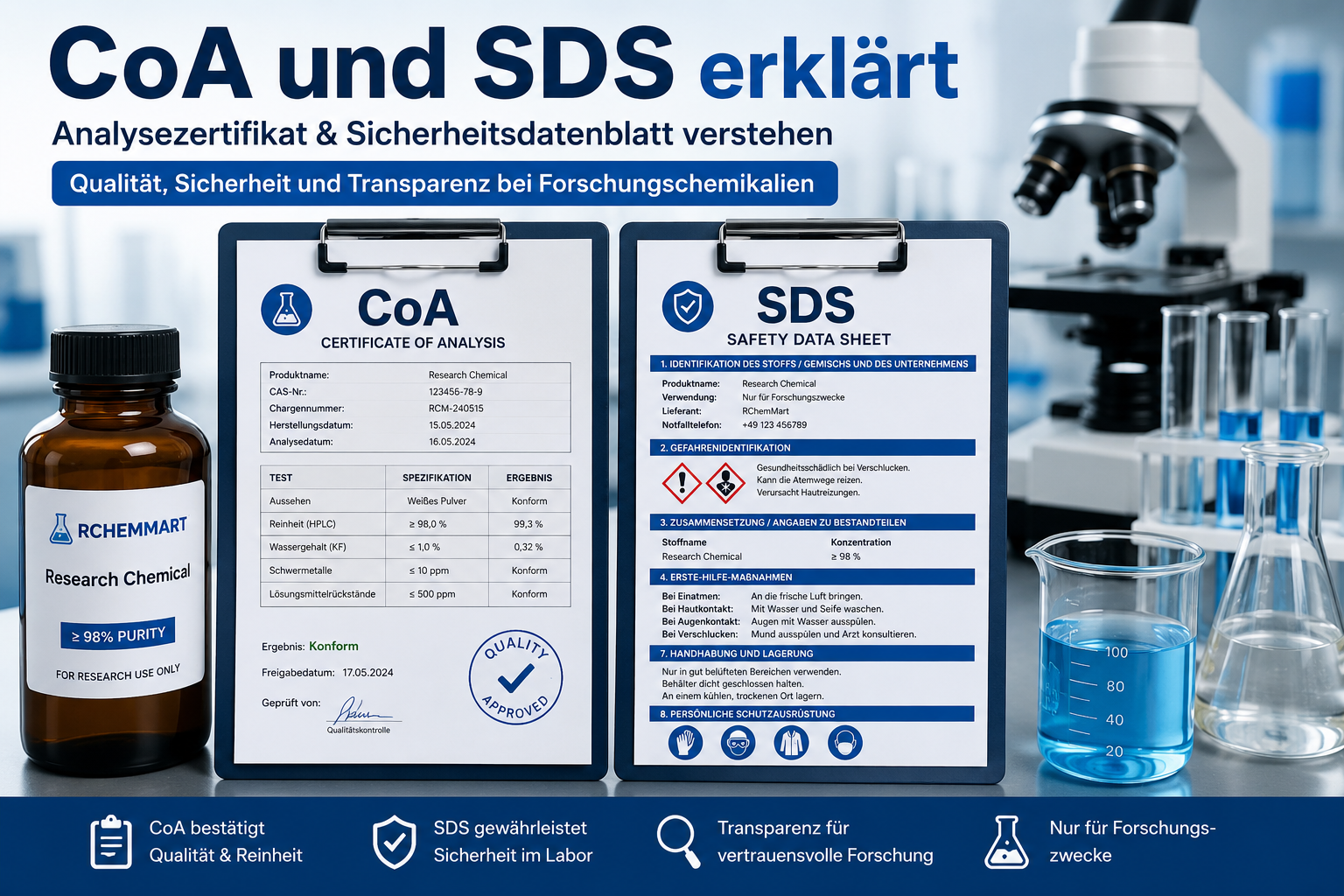
CoA und SDS erklärt: Warum diese Dokumente bei Forschungschemikalien unverzichtbar sind
CoA und SDS erklärt – Der Leitfaden für Forschungschemikalien
Wer Forschungschemikalien kaufen möchte, stößt häufig auf Begriffe wie CoA und SDS. Diese Dokumente spielen eine entscheidende Rolle bei der Qualitätskontrolle, Produktsicherheit und Transparenz von chemischen Substanzen.
Doch was genau bedeuten diese Abkürzungen? Warum sind sie wichtig und worauf sollten Forscher, Labore und wissenschaftliche Einrichtungen achten?
In diesem Leitfaden erklären wir CoA und SDS, ihre Unterschiede sowie ihre Bedeutung für die moderne Laborforschung.
Was ist ein CoA (Certificate of Analysis)?
Ein Certificate of Analysis (CoA), auf Deutsch Analysezertifikat, ist ein Dokument, das die Qualitätsmerkmale einer chemischen Substanz bestätigt.
Das CoA wird in der Regel von einem Labor oder Hersteller erstellt und enthält wichtige Informationen über die geprüfte Charge eines Produkts.
Typische Inhalte eines CoA
Ein Analysezertifikat enthält häufig:
- Produktname
- Chargennummer
- Herstellungsdatum
- Reinheitsgrad
- Analyseverfahren
- Testergebnisse
- Freigabedatum
- Unterschrift oder Freigabe durch das Labor
Das wichtigste Ziel eines CoA besteht darin, nachzuweisen, dass eine Forschungschemikalie den angegebenen Qualitätsstandards entspricht.
Warum ist ein CoA wichtig?
Für Forschungseinrichtungen und Labore ist die Qualität einer Substanz von entscheidender Bedeutung. Bereits geringe Verunreinigungen können Analyseergebnisse beeinflussen.
Ein CoA bietet daher mehrere Vorteile:
Nachweis der Reinheit
Forscher können den angegebenen Reinheitsgrad überprüfen und beurteilen, ob die Substanz für ihre Untersuchungen geeignet ist.
Rückverfolgbarkeit
Durch Chargennummern und Produktionsdaten kann jede Lieferung eindeutig identifiziert werden.
Qualitätskontrolle
Das Dokument bestätigt, dass die Substanz vor der Auslieferung getestet wurde.
Vertrauen und Transparenz
Ein professionelles Analysezertifikat schafft Vertrauen zwischen Lieferant und Kunde.
Was ist ein SDS (Safety Data Sheet)?
Ein Safety Data Sheet (SDS), auf Deutsch Sicherheitsdatenblatt, enthält wichtige Informationen zum sicheren Umgang mit chemischen Stoffen.
Während das CoA die Qualität eines Produkts beschreibt, konzentriert sich das SDS auf Sicherheitsaspekte.
Sicherheitsdatenblätter sind ein wesentlicher Bestandteil moderner Chemikalienverwaltung und helfen dabei, Risiken zu minimieren.
Welche Informationen enthält ein SDS?
Ein Sicherheitsdatenblatt umfasst normalerweise:
Produktidentifikation
- Produktname
- Herstellerinformationen
- Notfallkontakt
Gefahrenidentifikation
- Mögliche Gesundheitsrisiken
- Gefahrenhinweise
- Sicherheitshinweise
Erste-Hilfe-Maßnahmen
Anweisungen für den Fall einer Exposition oder eines Unfalls.
Handhabung und Lagerung
Empfehlungen für sichere Lagerbedingungen und den korrekten Umgang.
Persönliche Schutzausrüstung
Informationen zu:
- Handschuhen
- Schutzbrillen
- Atemschutz
- Schutzkleidung
Physikalische und chemische Eigenschaften
Wichtige Daten zur Identifikation und Verwendung der Substanz.
Warum ist ein SDS wichtig?
Ein SDS hilft Laborpersonal dabei, sicher mit chemischen Produkten umzugehen.
Zu den wichtigsten Vorteilen gehören:
- Verbesserter Arbeitsschutz
- Einhaltung gesetzlicher Vorgaben
- Sichere Lagerung
- Richtige Entsorgung
- Risikominimierung im Labor
Für professionelle Forschungseinrichtungen gehört die Verwendung von Sicherheitsdatenblättern zum Standard.
CoA und SDS – Die wichtigsten Unterschiede
Viele Kunden verwechseln diese beiden Dokumente. Dabei erfüllen sie unterschiedliche Aufgaben.
| CoA | SDS |
|---|---|
| Nachweis der Qualität | Nachweis der Sicherheit |
| Fokus auf Reinheit und Analyse | Fokus auf Gefahren und Schutzmaßnahmen |
| Chargenspezifisch | Produktbezogen |
| Bestätigung der Produktspezifikationen | Anleitung zum sicheren Umgang |
Einfach ausgedrückt:
- Das CoA zeigt, was im Produkt enthalten ist.
- Das SDS erklärt, wie sicher damit gearbeitet wird.
Warum hochwertige Forschungschemikalien Dokumentation benötigen
Professionelle Anbieter von Forschungschemikalien legen großen Wert auf Transparenz und Qualitätskontrolle.
Durch die Bereitstellung von CoA- und SDS-Dokumenten profitieren Kunden von:
- Höherer Produktsicherheit
- Besserer Nachvollziehbarkeit
- Präziseren Forschungsergebnissen
- Mehr Vertrauen in die Produktqualität
Gerade bei hochreinen Forschungschemikalien sind diese Dokumente ein wichtiger Bestandteil professioneller Qualitätsstandards.
Worauf sollte man beim Kauf von Forschungschemikalien achten?
Wenn Sie Forschungschemikalien kaufen, sollten Sie folgende Punkte berücksichtigen:
Verfügbarkeit eines CoA
Ein Analysezertifikat zeigt, dass die Substanz geprüft wurde und die angegebenen Spezifikationen erfüllt.
Verfügbarkeit eines SDS
Ein Sicherheitsdatenblatt unterstützt den sicheren Umgang und die korrekte Lagerung.
Reinheitsangaben
Seriöse Anbieter stellen klare Informationen zur Produktreinheit bereit.
Transparente Produktinformationen
Je detaillierter die Angaben, desto besser kann die Eignung für Forschungszwecke beurteilt werden.
Die Rolle von CoA und SDS in der modernen Forschung
Mit zunehmender Komplexität wissenschaftlicher Projekte steigt auch die Bedeutung von Qualitäts- und Sicherheitsdokumenten.
Forschungseinrichtungen, Universitäten und Laboratorien verlassen sich auf zuverlässige Informationen, um:
- reproduzierbare Ergebnisse zu erzielen,
- Risiken zu minimieren,
- regulatorische Anforderungen einzuhalten,
- wissenschaftliche Standards zu erfüllen.
CoA und SDS sind daher unverzichtbare Werkzeuge für professionelle Forschung und Laborarbeit.
Fazit
Wer Forschungschemikalien kaufen möchte, sollte die Bedeutung von CoA und SDS verstehen. Beide Dokumente erfüllen unterschiedliche, aber gleichermaßen wichtige Aufgaben.
Während das Certificate of Analysis (CoA) die Qualität und Reinheit einer Substanz bestätigt, liefert das Safety Data Sheet (SDS) wichtige Informationen zum sicheren Umgang mit chemischen Stoffen.
Die Verfügbarkeit dieser Dokumente ist ein wichtiges Qualitätsmerkmal professioneller Anbieter und unterstützt eine sichere, transparente und wissenschaftlich fundierte Laborarbeit.

