
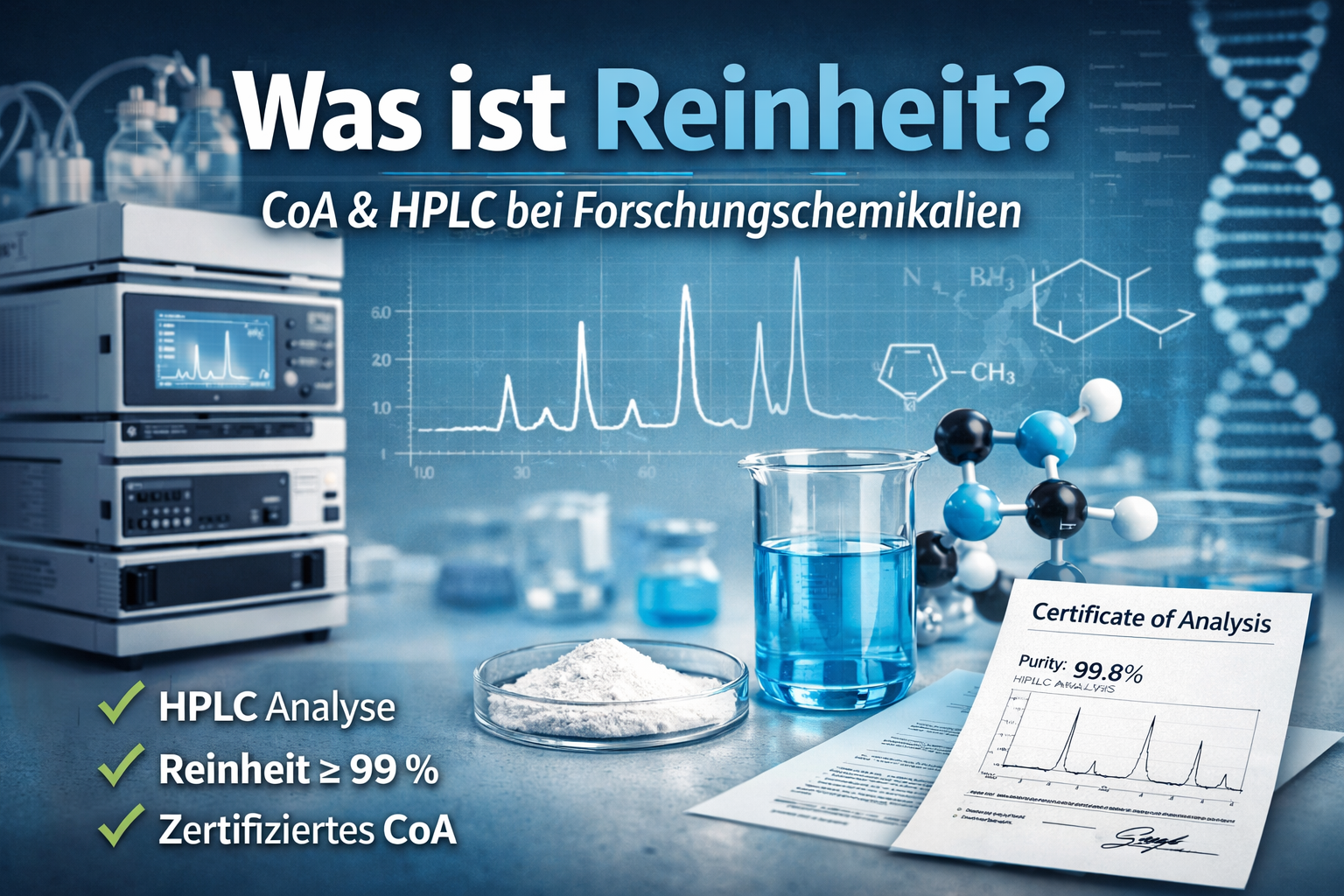
What is purity? Meaning of CoA & HPLC in Research Chemicals
Research Chemicals Purity, HPLC CoA, Testing Purity, Laboratory Quality Research Chemicals
Introduction
Who works with research chemicals knows: Purity is one of the most important quality factors. Unpure substances can falsify measurement results, make reactions unpredictable and endanger entire research projects. Terms and conditions CoA (Certificate of Analysis) and HPLC therefore appear in every serious research-chemicals shop. But what do they mean in concrete terms – and how do they help with the Purity of Research Chemicals reliable testing?
In this article you will learn what purity really means, why HPLC and CoA are indispensable and what laboratories 2025 should pay attention to to Laboratory quality at Research Chemicals ensure.
What does purity mean in research chemicals?
The Purity a research chemical indicates to what percentage the substance actually consists of the desired active substance. A purity 99 % means, for example, that only 1% consists of by-products, solvent residues or degradation products.
Why is purity so important?
-
Reproducibility: Experiments provide comparable results only when the substances used are constantly pure.
-
Security: Impurities can trigger unexpected reactions.
-
Validity: Scientific studies must be based on precisely defined substances.
In the sensitive field of research chemicals, a documented purity is therefore not a "bonus" but a must.
Typical impurities in Research Chemicals
The topic Research Chemicals Purity is not just about numbers, but about the type of possible impurities:
-
Synthesis products
-
Isomes or structurally related substances
-
residual solvent
-
degradation products by light, heat or moisture
Without professional analytics, these substances cannot be reliably identified – here come HPLC and CoA in the game.
What is a CoA (Certificate of Analysis)?
A Certificate of Analysis (CoA) is an official certificate of analysis that documents the quality of a research chemical. It is created either by the manufacturer or by an independent laboratory.
Typical content of CoA
-
Product name and batch number
-
Date of analysis
-
Certain purity (e.g. ≥ 98 %)
-
Analysis methods used (e.g. HPLC, NMR, GC-MS)
-
Name and signature of the laboratory
A CoA is therefore the most important evidence to Laboratory quality of Research Chemicals to judge objectively.
HPLC explains: Gold standard for purity testing
HPLC (High Performance Liquid Chromatography) is one of the most commonly used methods to determine the purity of research chemicals.
How does HPLC work?
-
The substance is dissolved in a solvent.
-
It is pressed by a special column.
-
Individual components separate due to their chemical properties.
-
A detector measures the concentration of each component.
The result is a Chromatogramin which each peak represents a substance.
Why is HPLC so important?
-
High accuracy: Even the smallest impurities are visible.
-
Quantitative: The purity can be given exactly in percent.
-
Standardized: Internationally recognized and reproducible.
Therefore, HPLC is considered as a reference method when it comes to: Testing purity of Research Chemicals.
HPLC & CoA – why do they belong together?
A CoA without specifying the analytical method is not meaningful. Only the combination of HPLC and CoA creates confidence:
-
HPLC provides the measurement data
-
The CoA documents these data
-
Labs can compare and archive batches
For professional users HPLC CoA therefore a central quality criterion for the purchase of research chemicals.
What purity is common in Research Chemicals?
In practice, the following target values have established:
-
≥ 98 % purity: Standard for most research purposes
-
≥ 99 % purity: High purity substances for sensitive analyses
-
< 98 % purity: Acceptable only with clear declaration
Serious providers give the purity transparent and demonstrate it through a current CoA.
How do you recognize reputable providers?
If Laboratory quality at Research Chemicals To make sure, pay attention to the following points:
-
Current CoAs for each batch
-
HPLC data or chromatograms on request
-
Clear product descriptions
-
EU-compliant safety data sheets (SDS)
-
Transparent origin of the analyses
For example, established providers such as rchemmart.com on documented purity, traceable analytics and EU-compliant standards.
Testing purity: Tips for laboratories
Quality can also be guaranteed in your own laboratory:
-
Archive CoA: For each batch separately
-
Compare batches: Deviations early
-
Keep in mind: Avoid heat, light and moisture
-
Regular post-analysis: Especially for longer storage time
So remains Purity of Research Chemicals in the long term.
Legal & scientific importance
Purity and documentation also play a legal role in Germany and the EU. For research chemicals:
-
Chemical Law & REACH Regulation
-
Mandatory marking
-
Detection of quality in laboratory operation
A complete HPLC CoA supports laboratories to meet regulatory requirements and minimize audit risks.
Conclusion
The question ‘What is purity?" is central in the field of research chemicals. Without reliable analysis, valid research results are hardly possible. HPLC provides precise measurement data while CoA this transparent document.
For 2025: Who Research Chemicals Purity takes seriously, should work exclusively with providers who HPLC CoA, clear purity and real Laboratory quality at Research Chemicals guarantee. Research, analysis and development remain safe, reproducible and scientifically resilient.

