
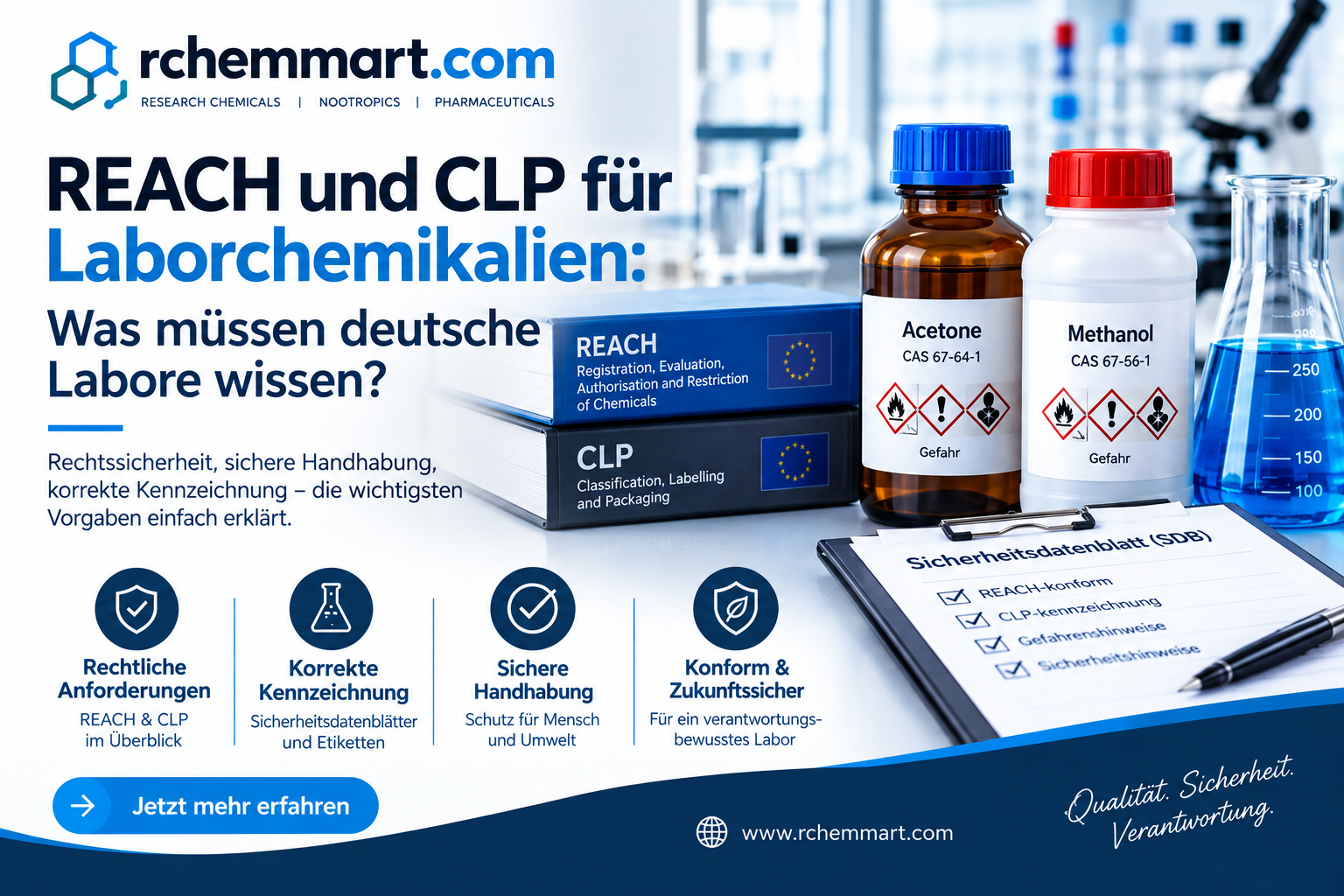
REACH and CLP for laboratory chemicals: What do German laboratories need to know?
Who? Laboratory chemicals in Germany shopping, storing or using should be aware of European chemicals regulations. Especially important are the REACH Regulation and the CLP Regulation, which lay down different but related requirements for chemical substances and mixtures.
For laboratories, this is not only about legal requirements. A correct Classification, marking, documentation and safe handling contributes significantly to reducing risks for employees, the environment and research results.
In this guide, RChemmart explains the most important basics of REACH CLP Laboratory Chemicals and shows what German laboratories should look for in 2026.
What does REACH mean?
REACH stands for Registration, Evaluation and Restriction of Chemicals. The European regulation regulates, among other things, the registration, evaluation, authorisation and restriction of chemical substances.
In principle, companies manufacturing or importing substances in the EU must provide certain information about their properties, uses and potential risks. For substances subject to registration, a threshold of one tonne per year; At the same time, there are exceptions and special regulations.
For a laboratory, this does not automatically mean that every chemical purchased must be registered itself. Decisive factors include the role of the company in the supply chain, the quantity used, the specific substance and possible exceptions.
What is the CLP Regulation?
CLP stands for Classification, Labelling and Packaging. The CLP Regulation specifies how hazardous substances and mixtures in the EU Classified, labelled and packaged ,.
Manufacturers, importers and downstream users shall classify and label hazardous substances and mixtures in accordance with the applicable criteria. The aim is to ensure a high level of protection of human health and the environment.
For laboratory chemicals the following labelling elements may be relevant, inter alia:
- Hazard Pictograms
- Signal words
- Hazard statements (H-phrases)
- Precautionary statements (P-phrases)
- Supplementary EUH statements
- Product identification
- Supplier details
The specific requirements depend on the classification of the particular substance or mixture.
REACH and CLP: What is the difference?
Although REACH and CLP often mentioned together, they perform different functions.
REACH focuses, inter alia, on information on chemical substances, their registration, use, authorisation and restrictions.
CLP Focus on the other hand on the Hazard classification, labelling and packaging of substances and mixtures.
Both sets of rules complement each other. For example, information on substance properties may be relevant for correct hazard assessment and labelling.
What do German laboratories have to consider when purchasing?
Before purchasing laboratory chemicals, a laboratory should check, as far as possible, whether sufficient information is available on the substance.
Particularly important are:
1. Unique substance identity
The chemical identity should be clearly traceable. Depending on the product, for example, name, CAS number, EC number or other identification features may be relevant.
2. Safety data sheet
For relevant hazardous substances and mixtures: Safety Data Sheet (SDS) a central role. It contains information on safe handling, storage, exposure, emergency response and other safety-related aspects.
3. Classification and labelling
Labelling should be consistent with the applicable CLP classification. For harmonised classified substances, the corresponding harmonised classifications shall be taken into account.
4. Purpose
Laboratories should check whether the intended use is compatible with the available information and, where applicable, with any restrictions or authorisation requirements.
5. Documentation
Structured documentation facilitates traceability of chemicals and can be helpful in internal safety audits or audits.
Why are restrictions important under REACH?
REACH does not only contain registration requirements. Certain substances may be: Restrictions or authorisation requirements subject.
Particularly relevant is, for example, Annex XVII the REACH Regulation, which sets out certain restrictions on substances and their use. The BAuA points out that REACH provides for both authorisation and restriction procedures for certain substances.
Therefore, a laboratory should not decide whether to use a chemical solely on the basis of the product name.
REACH CLP Laboratory Chemicals and Safety Data
Compliance with REACH and CLP is closely linked to good safety management in the laboratory.
Before using a chemical, employees should know, among other things:
- What are the risks?
- What personal protective equipment is required?
- How should the substance be stored?
- Which substances must not be combined?
- What to do about spills or releases?
- How should the chemical be disposed of?
The information should be verified against the available safety documentation and the operational risk assessment.
Changes and developments in 2026
Chemicals legislation is constantly evolving. In 2026, laboratories should therefore ensure that their information and labels are up-to-date.
The CLP Regulation also provides for transitional arrangements for certain new requirements. For certain substances and mixtures starting for the first time from: 1. July 2026 new requirements are already in place on the EU market; further labelling requirements apply from 2027 with appropriate transitional periods.
For companies, this means that old labels, safety information and internal documentation should be regularly checked for topicality.
What does this mean for research chemicals?
Also in Research chemicals the legal classification should not be flat-rate. The term "research chemical" or "research chemical" does not automatically mean that a substance is exempt from REACH or CLP.
Depending on the substance, quantity, intended use and role of the company, different requirements may apply.
Therefore, it is recommended before purchasing the Substance identity, safety information, applicable restrictions and intended use to check.
Checklist for German laboratories
A simple checklist can help in procuring laboratory chemicals:
✓ Unique identification of the substance
✓ Check current safety data sheet
✓ Check CLP classification and labelling
✓ Examine REACH status and possible restrictions
✓ Consider intended use
✓ Observe storage conditions
✓ Perform hazard assessment
✓ Inform employees accordingly
✓ Keep documentation and batch information traceable
BAuA also provides information on REACH and CLP. Their tools can help with orientation, but do not replace testing the regulations applicable to the respective laboratory.
RChemmart – Information for laboratory and research
At RChemmart, a transparent product presentation with relevant Product information and specifications at the centre. For research and analytics, it is important not only to select chemical products according to price or availability, but also to consider documentation, quality and safety information.
Who? Buy laboratory chemicals online Therefore, before ordering, you should carefully check the product information and ensure that the intended use is compatible with the applicable legal requirements.
Conclusion: Understanding REACH and CLP for laboratory chemicals
REACH CLP Laboratory Chemicals are an important topic for German laboratories that manufacture, import, purchase or use chemical substances.
In particular, REACH deals with the registration, evaluation, authorisation and restriction of chemicals, while CLP regulates the classification, labelling and packaging of hazardous substances and mixtures.
This is why laboratories are up-to-date safety data, correct labelling, unambiguous substance identity, appropriate documentation and review of legal restrictions particularly important.
As European and national regulations evolve, laboratories should regularly review their processes and seek expert advice in case of legal doubt.
RChemmart – Research Chemicals and Laboratory Information for Research and Analytics.

