
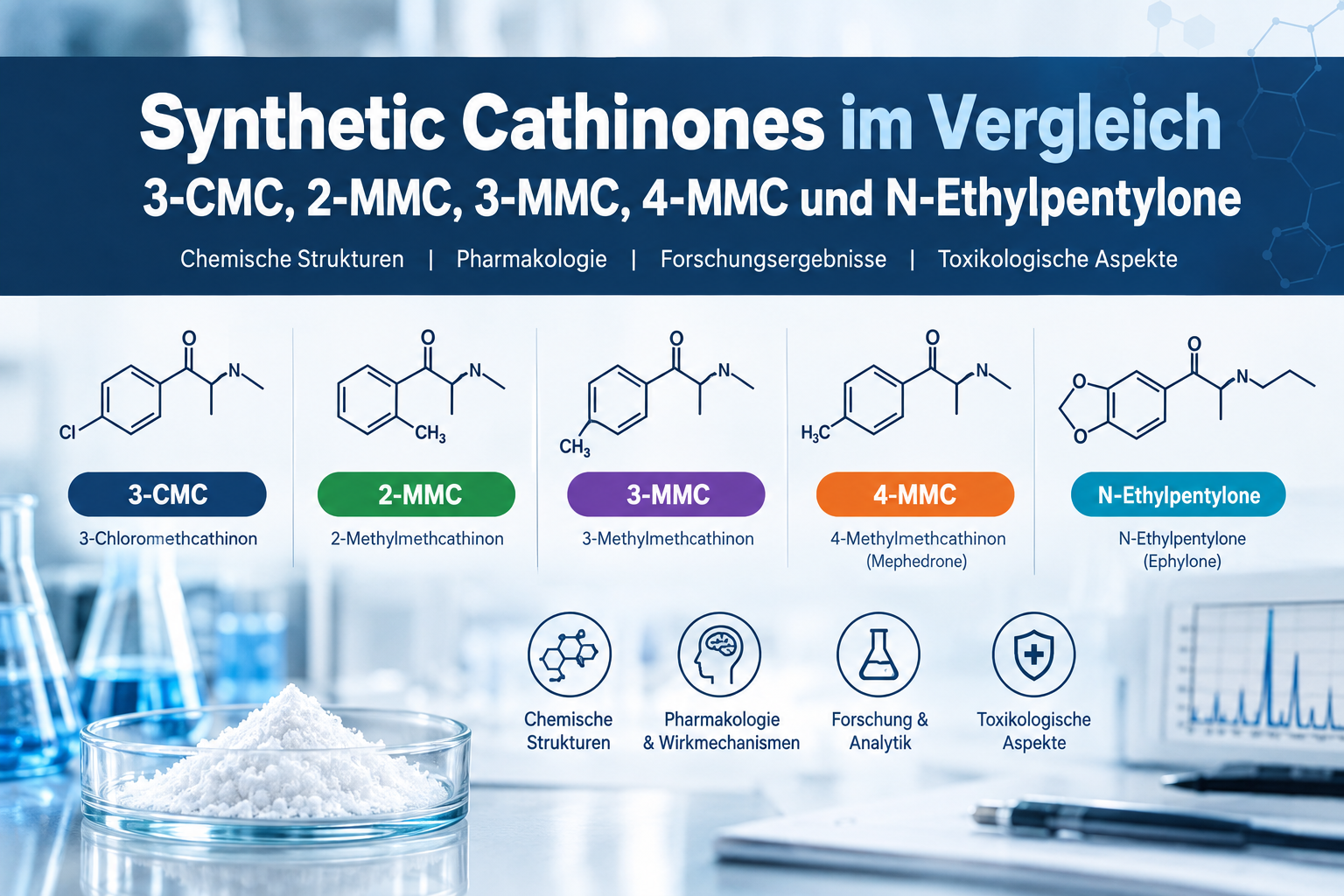
Synthetic Cathinones Compared: 3-CMC, 2-MMC, 4-MMC, 3-MMC and N-Ethylpentylone
Synthetic cathinones are a broad group of psychoactive compounds structurally related to cathinone, the naturally occurring stimulant found in the khat plant (Catha edulis). They are part of the wider category of new psychoactive substances (NPS) and have attracted considerable interest in forensic science, analytical chemistry, toxicology and public-health research.
Among the compounds that have appeared in scientific and forensic literature are 3-CMC, 2-MMC, 3-MMC, 4-MMC and N-ethylpentylone (ephylone). Although these substances share a cathinone backbone, relatively small structural differences can alter their interactions with dopamine, norepinephrine and serotonin transporters.
This article provides a scientific comparison of these five synthetic cathinones, focusing on their chemical characteristics, pharmacological profiles, research history and known toxicological concerns.
What Are Synthetic Cathinones?
Synthetic cathinones are β-keto phenethylamines. Their chemical structure is related to amphetamine-type stimulants, but they contain an additional carbonyl group on the side chain. According to the United Nations Office on Drugs and Crime (UNODC), synthetic cathinones generally act as central nervous system stimulants and can affect dopamine, norepinephrine and serotonin systems.
More than one hundred synthetic cathinone derivatives have been identified in forensic and drug-monitoring programs. Their pharmacological properties are not identical, meaning that one compound cannot automatically be used as a model for every other member of the class.
3-CMC vs 2-MMC vs 3-MMC vs 4-MMC vs N-Ethylpentylone
The following comparison provides a high-level overview:
| Compound | Chemical distinction | General research profile | Important consideration |
|---|---|---|---|
| 3-CMC | Chlorine substitution on the aromatic ring | Synthetic cathinone investigated in forensic and pharmacological research | Human toxicology data remain comparatively limited |
| 2-MMC | Methyl substitution at the ortho position | Emerging methylmethcathinone studied alongside 3-MMC and 4-MMC | Evidence base is still developing |
| 3-MMC | Methyl substitution at the meta position | Relatively well studied methylmethcathinone with pronounced stimulant-related pharmacology | Associated with cardiovascular and neurological risks |
| 4-MMC | Methyl substitution at the para position; mephedrone | Historically important synthetic cathinone with comparatively extensive literature | Significant stimulant and toxicological concerns |
| N-ethylpentylone | Ethyl-substituted pentylone derivative | Forensic and toxicological research focus | Serious intoxications and fatalities have been documented |
The table should not be interpreted as a ranking of safety, potency or suitability. Available evidence differs substantially between compounds.
3-CMC
3-CMC, or 3-chloromethcathinone, belongs to the chlorinated methcathinone family. Its structure resembles other methylmethcathinones, but a chlorine substituent replaces the corresponding hydrogen on the aromatic ring.
Compared with older and more extensively studied compounds such as 4-MMC, considerably less human pharmacological and toxicological information is available for 3-CMC. This is an important consideration when interpreting claims about its effects.
Recent laboratory research into cathinone transporter pharmacology indicates that positional changes in chlorine substitution can influence interactions with monoamine transporters. Such findings demonstrate why apparently small structural changes can produce meaningful pharmacological differences.
From a forensic perspective, 3-CMC is therefore of interest because analytical laboratories need to distinguish it from chemically related cathinones using techniques such as chromatography and mass spectrometry.
2. 2-MMC
2-MMC, or 2-methylmethcathinone, is one of three positional methylmethcathinone isomers commonly discussed alongside 3-MMC and 4-MMC.
The number preceding “MMC” refers to the position of the methyl group on the aromatic ring:
- 2-MMC — ortho position
- 3-MMC — meta position
- 4-MMC — para position
These compounds have the same basic molecular formula but different arrangements of atoms. This makes them regioisomers.
Recent research examining 2-MMC, 3-MMC and 4-MMC found that their interactions with dopamine, norepinephrine and serotonin transporters differ despite their close structural relationship.
2-MMC has become particularly relevant to drug-monitoring research because its appearance has been associated with changes in the availability of other methylmethcathinones. Researchers emphasize that the health-risk evidence for 2-MMC remains incomplete.
3. 3-MMC
3-MMC, or 3-methylmethcathinone, is the meta-substituted member of the MMC family.
It has received considerably more scientific attention than 2-MMC because of its appearance in European drug markets and subsequent toxicological investigations.
Research comparing the three MMC regioisomers indicates that 3-MMC has substantial activity at dopamine and norepinephrine transport systems. One recent review reported that 3-MMC showed greater releasing-agent potency at dopamine and norepinephrine transporters than the corresponding 2-MMC and 4-MMC comparisons in certain experimental systems.
Clinical and toxicological literature has associated synthetic cathinones such as 3-MMC with effects including tachycardia and agitation. Cardiovascular complications are an important area of concern when studying this class.
Importantly, laboratory transporter measurements should not be interpreted as direct predictions of human effects. Experimental conditions, metabolism, dose exposure and individual physiology can all influence outcomes.
4. 4-MMC — Mephedrone
4-MMC, commonly known as mephedrone or 4-methylmethcathinone, is one of the best-known synthetic cathinones.
Its para-position methyl group distinguishes it from the 2-MMC and 3-MMC regioisomers. Because 4-MMC appeared relatively early in the modern synthetic-cathinone market, it has been investigated more extensively than many newer derivatives.
Studies comparing 2-MMC, 3-MMC and 4-MMC have found differences in their relative activity at dopamine, norepinephrine and serotonin transporters. Research suggests that 4-MMC has comparatively greater serotonergic selectivity than 3-MMC in some experimental models.
4-MMC has also been associated with cardiovascular effects and other adverse reactions. A broader review of synthetic-cathinone cardiotoxicity reports that 4-MMC and 3-MMC can produce sympathomimetic effects, including cardiovascular stimulation.
Because of its relatively extensive research history, 4-MMC is frequently used as a reference compound when scientists investigate newer synthetic cathinones.
5. N-Ethylpentylone
N-ethylpentylone, also known as ephylone or N-ethylnorpentylone, belongs to a different structural subgroup from the MMC compounds discussed above.
Unlike 2-MMC, 3-MMC and 4-MMC, N-ethylpentylone contains a methylenedioxy-substituted aromatic ring and an N-ethyl modification. Its pharmacological profile is therefore different from that of the methylmethcathinones.
Laboratory research has shown that N-ethylpentylone strongly inhibits dopamine and norepinephrine transporters, with weaker activity at the serotonin transporter under the experimental conditions studied.
The compound is particularly important in forensic toxicology because serious intoxications have been documented. A UK clinical toxicology study identified cases involving tachycardia, agitation, confusion, hallucinations, acidosis and elevated creatine kinase. Co-use of other substances was common in several cases, making interpretation of individual effects more complicated.
Separate case reports have documented severe hyperthermia, rhabdomyolysis, cardiovascular complications and death involving N-ethylpentylone.
Key Chemical and Pharmacological Differences
The most important distinction between these compounds is their molecular structure.
2-MMC, 3-MMC and 4-MMC are positional isomers. The methyl group occupies different locations on the aromatic ring, which can change their interactions with monoamine transporters.
3-CMC introduces chlorine substitution instead of the methyl-substitution pattern found in MMC compounds.
N-Ethylpentylone has a substantially different substitution pattern and therefore should not simply be considered another MMC analogue.
These differences matter because synthetic cathinones do not form a pharmacologically uniform group. Scientific reviews emphasize that individual compounds can differ in transporter activity, metabolism, toxicity and potential for adverse effects.
Synthetic Cathinones and Toxicology
A major challenge in synthetic-cathinone research is the limited amount of high-quality human data available for many newer compounds.
Reported complications across the wider class include:
- Increased heart rate and blood pressure
- Agitation and confusion
- Hyperthermia
- Hallucinations and psychotic symptoms
- Seizures
- Cardiovascular complications
- Rhabdomyolysis
- Loss of consciousness
- Potentially fatal intoxication
A systematic review of synthetic-cathinone neurotoxicity identified neurological complications ranging from agitation and psychosis to seizures, coma and death.
Another systematic review found an association between synthetic-cathinone exposure and psychotic symptoms, although the authors noted substantial differences between studies and limitations in establishing precise prevalence estimates.
These findings demonstrate why analytical identification and toxicological monitoring are important when dealing with unknown or suspected synthetic-cathinone exposure.
Why Structural Comparison Matters in Laboratory Research
For analytical laboratories, distinguishing closely related cathinones is essential. Compounds that have similar names or molecular structures cannot necessarily be identified reliably from appearance alone.
For example, UNODC analytical guidance describes methods for differentiating 2-MMC, 3-MMC and 4-MMC using instrumental techniques.
Modern forensic laboratories may use techniques including:
- Gas chromatography–mass spectrometry (GC-MS)
- Liquid chromatography–mass spectrometry (LC-MS/MS)
- Infrared spectroscopy
- High-resolution mass spectrometry
- Reference standards and validated analytical procedures
Such methods allow researchers to determine the identity and concentration of compounds in biological samples or seized materials.
Conclusion
3-CMC, 2-MMC, 3-MMC, 4-MMC and N-ethylpentylone belong to the broad synthetic-cathinone family, but they are not pharmacologically interchangeable.
The MMC compounds illustrate how the position of a single methyl group can influence transporter activity, while 3-CMC demonstrates the effect of changing the aromatic substituent. N-ethylpentylone represents a structurally different cathinone with documented forensic and toxicological significance.
For researchers, toxicologists and analytical laboratories, these distinctions are important when interpreting analytical results, studying structure–activity relationships and evaluating emerging new psychoactive substances.
Because evidence for newer synthetic cathinones remains incomplete, laboratory findings should be interpreted carefully, and claims about relative safety or effects should not be extrapolated from one compound to another without supporting evidence.

