
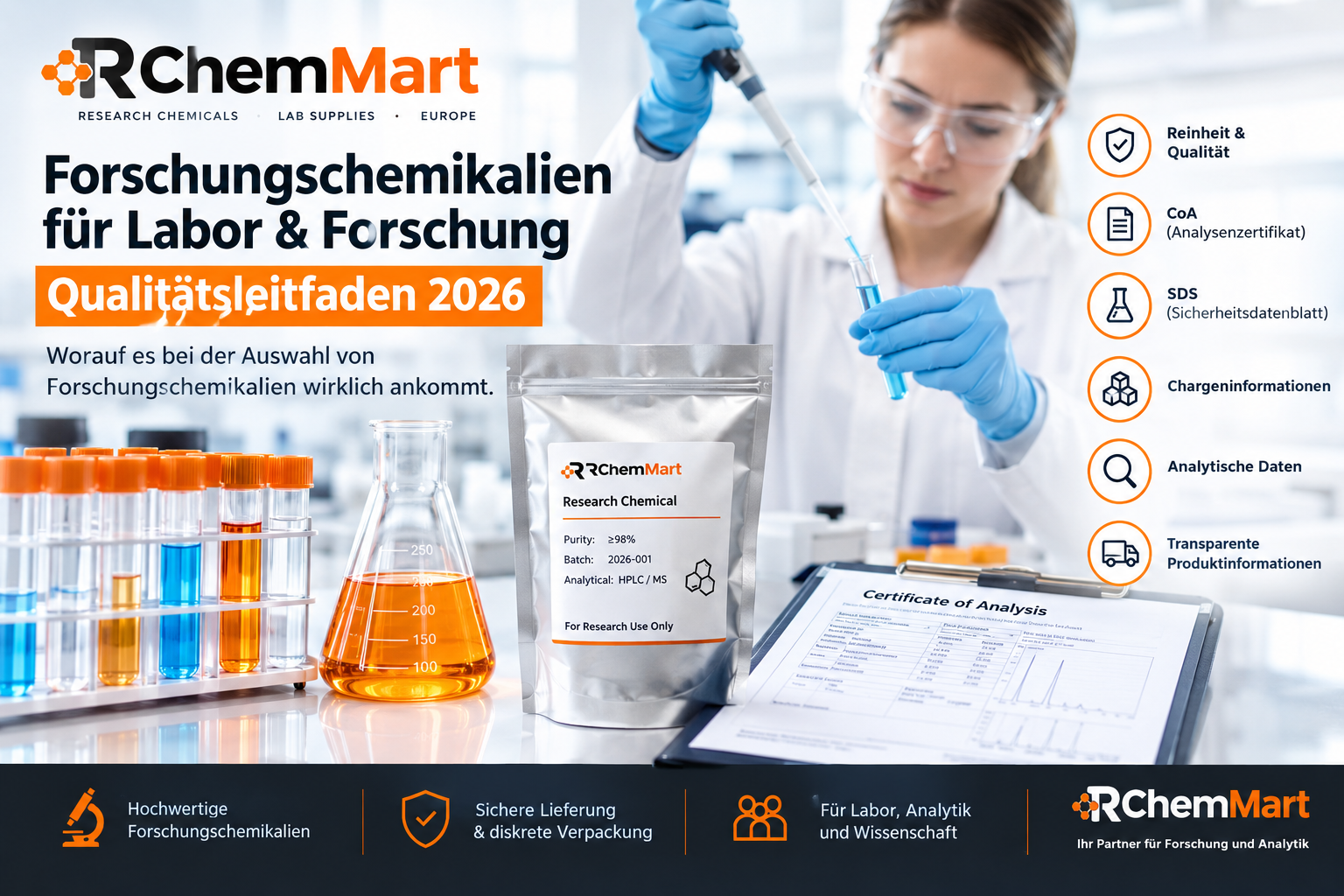
Research Chemicals for Laboratory & Research – Quality Guide 2026
Research chemicals are an important part of modern laboratory research, analytical chemistry and scientific investigations. For professional users, however, not only the product name or a specified purity counts. Also crucial are clear product identification, traceable quality data, batch information and suitable security documents.
Who? Research chemicals for laboratory and research selects, should therefore compare different quality characteristics with each other. This guide shows what particular attention should be paid to when evaluating research and laboratory chemicals.
What should you look for in research chemicals?
When selecting more appropriate Research chemicals laboratories and scientific institutions should take into account several pieces of information. These include in particular:
- Unique product identification
- traceable purity information
- Batch and solder information
- Certificate of Analysis (CoA)
- Safety Data Sheet (SDS)
- Information on storage and handling
- Analytical information
- Transparent product description
- clear indication of the intended purpose of the research
The most complete documentation possible facilitates the evaluation of a material and can help to make laboratory processes more traceable and reproducible.
Why is the quality of research chemicals important?
The quality of a material can influence the significance of analytical and scientific investigations. Therefore, Research chemicals are not assessed solely on the basis of the product name or a single purity value.
Particularly relevant are the combination of Product identity, purity, batch data and analytical documentation.
For professional users, this means that the more transparent the information available, the easier it is to assess whether a material is suitable for the intended scientific or analytical purpose.
What is a Certificate of Analysis (CoA)?
A Certificate of Analysis (CoA) is an important quality document for chemical materials. It usually refers to a certain batch and may contain different analytical data depending on the product.
These may include, for example:
- Product and batch designation
- specified identity
- Purity value
- Analytical methods used
- Measurement results
- Test date
- Batch related information
A CoA allows laboratory users to better understand the available quality information of a given batch.
CoA and analytical purity
A stated purity should always be associated with the respective Analytical method be considered. Different methods can be used depending on the material and target.
Commonly used analytical methods include, for example:
- HPLC
- GC
- GC-MS
- LC-MS
The significance of an analytical result depends, inter alia, on the method used, the test conditions and the respective sample.
If you want to learn more about this topic, you can follow our guide to CoA, HPLC and analytical purity use.
Properly classify purity of research chemicals
The term Purity does not automatically describe all the properties of a material. A high stated purity value should therefore not be considered in isolation.
In addition, the following information may be relevant for an informed assessment:
Product identity: Is the material clearly documented?
Batch information: Is the material assigned to a specific batch or solder?
Analytical test: Does it indicate which method was used for quality verification?
Documentation: Is CoA or other relevant quality information available?
Safety information: Are there any appropriate instructions for safe handling and storage?
These points provide a better basis for professional evaluation than a single percentage.
Sicherheitsdatenblatt (SDS) bei Laborchemikalien
Neben analytischen Informationen spielen Safety Data Sheets (SDS) eine wichtige Rolle bei der professionellen Arbeit mit Chemikalien.
Ein SDS kann unter anderem Informationen zu folgenden Bereichen enthalten:
- Gefahreneigenschaften
- sichere Handhabung
- Storage
- persönliche Schutzmaßnahmen
- Unintended release measures
- Transportinformationen
- Disposal instructions
Laboranwender sollten vor der Verwendung eines Materials die verfügbaren Sicherheitsinformationen sorgfältig prüfen und die geltenden Vorschriften und Laborstandards beachten.
Forschungschemikalien und transparente Produktinformationen
Bei der Auswahl von Laborchemikalien und Forschungschemikalien ist Transparenz ein wichtiger Faktor. Produktinformationen sollten möglichst klar, nachvollziehbar und konsistent dargestellt werden.
In RChemMart liegt der Fokus auf übersichtlichen Produktinformationen und der Bereitstellung relevanter Qualitäts- und Dokumentationsmerkmale. Anwender können dadurch verschiedene Informationen wie Produktbezeichnung, Reinheitsangaben und verfügbare Dokumentation besser miteinander vergleichen.
Vor einer Verwendung sollte stets geprüft werden, ob ein Material für den vorgesehenen wissenschaftlichen oder analytischen Zweck geeignet ist und ob sämtliche geltenden gesetzlichen und institutionellen Anforderungen eingehalten werden.
Checkliste: Forschungschemikalien professionell bewerten
Who? Buying research chemicals oder für wissenschaftliche Zwecke beschaffen möchte, sollte vor einer Entscheidung insbesondere folgende Punkte überprüfen:
☑ Eindeutige Produktbezeichnung
☑ Klare Identifikation des Materials
☑ Angegebene Reinheit
☑ Chargen- oder Lotnummer
☑ Certificate of Analysis (CoA)
☑ Verfügbare analytische Daten
☑ Sicherheitsdatenblatt (SDS)
☑ Informationen zu Lagerung und Handhabung
☑ Transparente Produktbeschreibung
☑ Eignung für den vorgesehenen Forschungszweck
☑ Einhaltung der geltenden Vorschriften
Diese Checkliste kann als praktische Orientierung dienen, wenn verschiedene Anbieter oder Produktinformationen miteinander verglichen werden.
Forschungschemikalien für Labor, Analytik und Wissenschaft
Moderne Laboratory research stellt hohe Anforderungen an die Nachvollziehbarkeit verwendeter Materialien. Deshalb sollten Forschungschemikalien nicht nur nach Verfügbarkeit oder Preis beurteilt werden.
Eine Kombination aus klarer Produktidentifikation, dokumentierter Reinheit, CoA, analytischen Informationen und Sicherheitsdokumentation schafft eine bessere Informationsgrundlage für professionelle Laboranwender.
Insbesondere bei analytischen Untersuchungen und reproduzierbaren Forschungsprozessen ist eine möglichst transparente Dokumentation von Bedeutung.
Fazit: Qualität und Dokumentation im Mittelpunkt
The selection of suitable Research chemicals sollte nicht ausschließlich anhand eines Produktnamens oder einer einzelnen Reinheitsangabe erfolgen. Eine professionelle Bewertung berücksichtigt ebenso Produktidentifikation, Chargeninformationen, Certificate of Analysis (CoA), analytische Daten und Safety Data Sheets (SDS).
Wer Forschungs- und Laborchemikalien bewertet, sollte deshalb auf nachvollziehbare Produktinformationen und eine möglichst transparente Dokumentation achten.
RChemMart bietet einen übersichtlichen Zugang zu Informationen rund um Forschungschemikalien, Laborchemikalien und Qualitätsdokumentation.
Weitere Informationen
Entdecken Sie die Forschungs- und Laborinformationen von RChemMart und informieren Sie sich über verfügbare Produkte, Qualitätsmerkmale und relevante Dokumentationsangaben für wissenschaftliche und analytische Anwendungen.

