
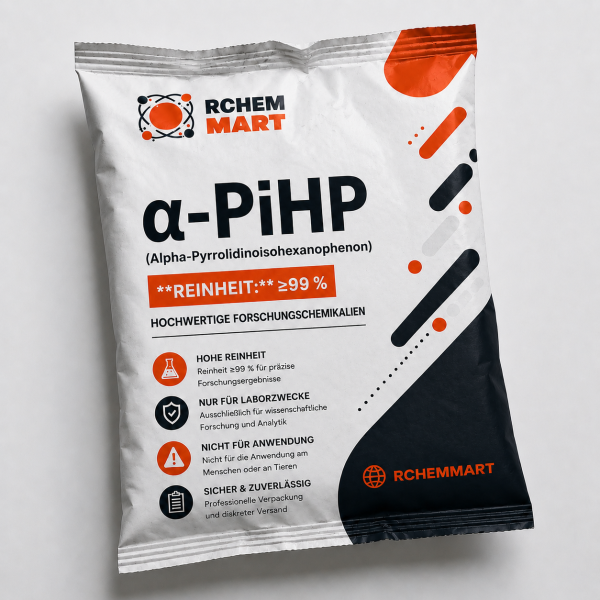
Buy α-PiHP
α-PiHP Research Chemical – Chemical Profile & Analytical Information
α-PiHP, also known as Alpha PiHP or α-Pyrrolidinoisohexanophenone, is a synthetic cathinone compound of scientific interest, particularly in the field of analytical chemistry, forensic research and the study of novel psychoactive substances.
Rchemmart lists α-PiHP as High purity research and analytical product with a declared purity of ≥99 %. The specific batch quality should be based on the respective Certificate of Analysis (COA) are checked.
Due to its specific molecular structure, α-PiHP can be characterised by chromatographic, mass spectrometric and other analytical methods and distinguished from structurally related compounds.
α-PiHP Chemical information
| Characteristics | Specifications | |
|---|---|---|
| Product name | α-PiHP | |
| Common name | Alpha PiHP | |
| Alternative name | α-Pyrrolidinoisohexanophenone | |
| Chemical class | Synthetic cathinone | |
| CAS number | 2181620-71-1 | |
| Molecules | C16H23NO | |
| molecular weight | 245,36 g/mol | |
| Purity | ≥99 % | |
| IUPAC name | 4-methyl-1-phenyl-2-(pyrrolidin-1-yl)pentan-1-one | |
| Research area |
|
|
α-PiHP molecular structure
α-PiHP has the molecular formula C16H23NO and a molecular weight of approx. 245,36 g/mol.
The chemical structure of α-PiHP contains several characteristic structural features:
- Phenyl group Aromatic benzene ring within the molecular structure
- Ketone group – characteristic functional group of the connection
- Pyrrolidine ring Nitrogen-containing five-membered heterocycle
- Branched carbon chain
- Chiral centre, whereby stereoisomeric forms are possible
The structure can be described by the following SMILES notation:
CC(C)CC(N1CCCC1)C(C2=CC=CC=C2)=O
These chemical identifiers can be used for database searches, analytical method development, structural verification and comparison with reference materials.
α-PiHP purity – ≥ 99 %
The stated analytical purity of this α-PiHP material is:
Purity: ≥99 %
The actual batch quality should always be combined with the respective Certificate of Analysis (COA) and the analytical method used.
For professional documentation, the following information may be relevant, inter alia:
- Lot or batch number
- Analytical purity value
- Test method used
- Date of analysis
- Reference material
- Chromatographic data
- Mass spectrometric data
The batch-specific COA is the relevant documentation to verify the stated purity.
Analytical research with α-PiHP
α-PiHP can be analytically studied in scientific studies on synthetic cathinones and novel psychoactive substances.
Possible analytical areas include:
LC-MS/MS:
Liquid chromatography coupled with tandem mass spectrometry can be used for the identification and analytical characterisation of compounds.
GC-MS:
Gas chromatography coupled with mass spectrometry enables the investigation of characteristic chromatographic and mass spectrometric properties.
HPLC:
High performance liquid chromatography can be used for chromatographic separation and for analytical examination of the sample composition.
NMR spectroscopy:
Nuclear magnetic resonance spectroscopy can contribute to the structural characterisation and confirmation of chemical compounds.
The appropriate analytical method depends on the research objective, the sample matrix, the laboratory equipment available and the validated laboratory methods.
α-PiHP in forensic chemistry
Synthetic cathinones represent an important area of forensic analysis, as structurally similar compounds must be distinguished by specific analytical characteristics.
For example, research on α-PiHP can focus on the following areas:
- Chemical identification
- Comparison with reference materials
- Chromatographic characterisation
- Mass spectrometric analysis
- Development of analytical methods
- Novel substances monitoring
- Structural characterisation
- Analytical detection
Validated analytical methods and correspondingly characterised reference materials should be used for reliable identification.
Difference Between α-PiHP and Related Compounds
α-PiHP should not be associated with similarly designated compounds such as α-PHP Being confused.
Although the names and certain chemical properties may appear similar, they are different chemical compounds. Therefore, for correct scientific documentation, the full chemical name, CAS number, molecular structure and analytical data should always be checked.
For α-PiHP the corresponding identifier is:
CAS: 2181620-71-1
Laboratory handling and storage
α-PiHP should only be handled by appropriately trained personnel and under appropriate laboratory conditions.
When working with research chemicals, the respective institutional safety rules and the security documents provided should be respected.
Relevant areas include:
- Appropriate personal protective equipment
- Chemical hygiene
- Avoidance of unnecessary exposure
- Proper storage
- Laboratory containment
- Chemical waste management services
- Chemical inventory
- Safety and product documentation
The specific storage conditions should be determined on the basis of the available safety documentation and the laboratory requirements applicable to the substance.
Legal and regulatory advice
The legal status of α-PiHP may vary by country and jurisdiction and may be adjusted by changes in legislation.
Before carrying out a scientific study, research organisations should therefore examine the current regulations for their respective locations. This may concern, in particular, provisions concerning possession, import, transport, storage and analytical use.
α-PiHP Research Chemical – Summary
α-PiHP (Alpha-PiHP) is a synthetic cathinone compound with the CAS No 2181620-71-1, the molecular formula C16H23NO and a molecular weight of about 245,36 g/mol.
The systematic chemical name is:
4-methyl-1-phenyl-2-(pyrrolidin-1-yl)pentan-1-one
The material specified here has a declared purity of ≥99 % on. The exact batch specification should be verified using the appropriate certificate of analysis (COA).
Important product specifications
- Product: α-PiHP
- Common name: Alpha PiHP
- CAS number: 2181620-71-1
- Chemical class: Synthetic cathinone
- Molecular formula: C16H23NO
- Molecular weight: 245,36 g/mol
- Purity: ≥99 %
- IUPAC name: 4-methyl-1-phenyl-2-(pyrrolidin-1-yl)pentan-1-one
- Alternative name: α-Pyrrolidinoisohexanophenone
- Research areas: Analytical chemistry, forensic research and chemical characterisation
- Possible methods of analysis: HPLC, GC-MS, LC-MS/MS, NMR and other validated laboratory methods
Frequently Asked Questions about α-PiHP
What is α-PiHP?
α-PiHP, also known as alpha-PiHP, is a synthetic cathinone compound studied in analytical, chemical and forensic research.
What is the CAS number of α-PiHP?
The CAS number of α-PiHP shall be: 2181620-71-1.
What is the molecular formula of α-PiHP?
The molecular formula is C16H23NO.
What is the molecular weight of α-PiHP?
The molecular weight is approximately 245,36 g/mol.
What is the purity of α-PiHP?
The purity indicated is ≥99 %. For a batch-specific confirmation, the corresponding Certificate of Analysis (COA) should be used.
How can α-PiHP be analytically identified?
Depending on the research objective, among other things LC-MS/MS, GC-MS, HPLC and NMR spectroscopy for analytical characterization. Appropriate reference materials and validated laboratory methods should be used.
Is α-PiHP the same as α-PHP?
α-PiHP and α-PHP are different chemical compounds. Due to the similar designations, the complete chemical identity should always be checked in scientific work.



Reviews
There are no reviews yet.